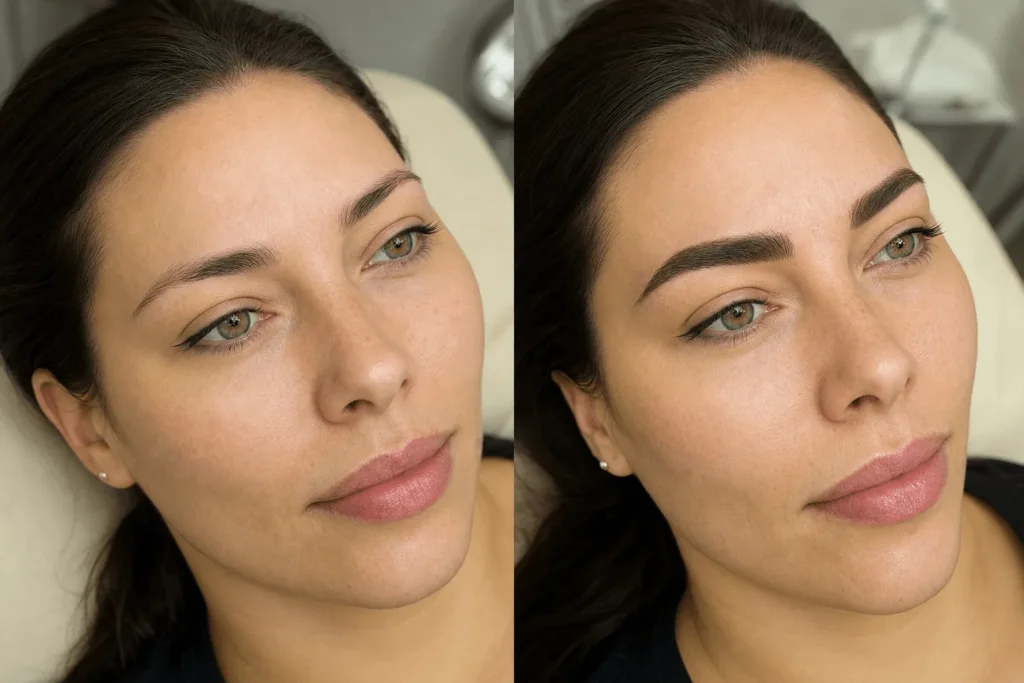
Microblading touch-ups determine whether your brows remain crisp and defined or fade into uneven patches. Understanding when to schedule your first microblading touch-up and recognizing the signs that you need maintenance ensures your semi-permanent cosmetic tattoo stays vibrant and symmetrical for months to come.
This guide covers the optimal timing for your perfecting session, how often you’ll need annual maintenance touch-ups, and what factors like skin type and Montreal’s climate affect microblading pigment retention. You’ll learn to identify visual cues that signal it’s time for a refresh and what to expect during each type of touch-up appointment.
Quick Answer
Your first microblading touch-up should occur 4-8 weeks after your initial session to perfect pigment retention and symmetry. After that, most clients need annual maintenance touch-ups every 12-18 months to refresh faded strokes and maintain color vibrancy.
What Is a Microblading Touch-Up and Why Is It Essential?
A microblading touch-up is a follow-up session where your PMU artist refines the initial work by filling in areas where pigment didn’t fully retain, adjusting color intensity, and perfecting the hair stroke technique. The first touch-up, often called the microblading perfecting session, is a critical part of the two-session process required to achieve optimal results.
During your initial microblading appointment, tiny blade strokes deposit pigment into the superficial dermal layer of your skin. As your brows heal over the following weeks, they pass through distinct phases: initial darkness, flaking, ghosting (where strokes appear faded), and finally settling into their true color.
This healing process reveals how your unique skin type accepts and retains the pigment. Some areas may heal lighter than others, certain strokes might not take at all, and the overall color intensity typically settles 20-40% lighter than it appeared immediately after your first session.
The perfecting session addresses these natural variations. At Fantasy Beauty in Mont-Royal, Leila Ghadyani uses this second appointment to layer additional pigment in areas that faded more than expected, refine the brow shape based on how the healed strokes settled, and ensure both brows remain symmetrical and natural-looking.
Key Takeaways
- Schedule your first touch-up between 4-8 weeks after initial microblading session.
- Expect annual maintenance every 12-18 months to maintain stroke definition and vibrancy.
- Watch for patchy areas, faded color, or softened strokes as touch-up indicators.
- Oily skin types require more frequent touch-ups than dry or normal skin.
- Missing your perfecting session window may require color correction or full redo.
When Should You Schedule Your First Microblading Touch-Up?
The optimal window for your first microblading touch-up is 4-8 weeks after your initial session. This timing allows complete healing while the pigment remains fresh enough to layer additional strokes seamlessly.
Before this window, your skin hasn’t fully healed from the initial procedure. The epidermis is still regenerating, and remnants of scabbing or flaking may persist. Attempting to add pigment during incomplete healing increases the risk of pushing out existing color or creating uneven saturation.
After 8 weeks, the pigment becomes more set in the skin, and the strokes may have faded enough that the touch-up functions more like a full refresh than a perfecting session. In Montreal’s humid summers, some clients find their skin retains moisture longer, which can extend the ideal healing window slightly toward the 7-8 week mark.
At week 4, your brows have completed the day-by-day healing timeline, passed through the ghosting phase, and revealed their true healed color. You can assess which areas retained pigment well and which need reinforcement.
| Healing Stage | Timeline | Touch-Up Readiness |
|---|---|---|
| Initial healing and flaking | Days 1-14 | Too early, skin still healing |
| Ghosting phase | Days 15-21 | Too early, pigment still settling |
| True color reveal | Days 28-35 | Ideal window begins |
| Optimal touch-up window | Weeks 4-8 | Best time for perfecting session |
| Extended window | Weeks 8-12 | Still possible, may need more work |
Most PMU artists, including the team at Fantasy Beauty, schedule your perfecting session during your initial appointment consultation. This ensures you secure a spot within the optimal window and don’t lose momentum in achieving your final brow goals.
We schedule your perfecting session at the end of your initial appointment because Montreal summers can affect healing. If you’re booking in June or July, plan your first session knowing the humidity may slow healing by 3-5 days.
Signs You Need a Touch-Up: How to Know It’s Time
Visual assessment is the most reliable way to determine if you need a microblading maintenance touch-up. Several distinct changes occur as pigment naturally fades over time, and recognizing these signs helps you schedule your refresh before your brows lose definition entirely.
Color Changes and Fading Intensity
The first sign most clients notice is overall color lightening. Your brows gradually shift from their rich, defined healed color to a softer, muted version. If your brows originally healed to a medium brown and now appear light taupe, or if dark brown strokes have faded to reddish-brown, it’s time for a touch-up. Color shifts toward warm tones (red or orange undertones) occur when cooler ash pigments fade faster than warmer base tones.
Stroke Definition and Blurring
Microblading creates crisp hair-like strokes that mimic natural brow hairs. As months pass, these strokes soften at the edges and lose their sharp definition. If you can no longer see individual strokes when viewing your brows from a normal distance, your microblading has entered the maintenance window.
Patchy Areas and Uneven Retention
Some sections of your brows may fade faster than others, creating patchy or uneven appearance. This happens more frequently in areas where skin is oilier, where you frequently apply skincare products, or where sun exposure is more direct. At Fantasy Beauty, clients often notice the tail of the brow fades faster than the body, or that one brow appears lighter than the other.
Take monthly photos of your brows in the same lighting to track fading objectively. What you see daily in the mirror can mask gradual changes that photos reveal clearly. We recommend this to all clients at our women-only studio in Mont-Royal.
How Often Do You Need Touch-Ups After the First Perfecting Session?
After your initial two-session process (the first appointment and the 4-8 week perfecting session), most clients need a microblading maintenance touch-up every 12-18 months. This timeline varies based on skin type, lifestyle factors, and pigment retention rates.
Clients with oily or combination skin typically need refreshes closer to the 10-12 month mark, while those with dry or normal skin can often extend to 16-18 months. Skin type affects how quickly your body breaks down and metabolizes the pigment particles deposited during microblading.
Ready to book your treatment?
Visit Leila Ghadyani at our Mont-Royal studio for a personalized consultation and expert permanent makeup treatment.
If you allow your microblading to fade completely (typically after 2-3 years without maintenance), the next session won’t technically be a touch-up. It will function more like a new initial procedure because the artist needs to recreate the entire brow design from scratch rather than simply refreshing existing work.
| Skin Type | Typical Touch-Up Frequency | Retention Characteristics |
|---|---|---|
| Oily skin | 10-12 months | Faster pigment breakdown, strokes blur sooner |
| Combination skin | 12-14 months | Moderate retention, may fade unevenly |
| Normal skin | 14-16 months | Balanced retention across brow area |
| Dry skin | 16-18 months | Best retention, strokes stay crisp longer |
| Mature skin (50+) | 10-14 months | Variable retention, may need gentler technique |
What Factors Affect How Long Your Microblading Lasts?
Multiple variables determine how frequently you’ll need touch-ups beyond the initial perfecting session. Understanding these factors helps you set realistic expectations for maintenance timing and adjust your aftercare to maximize pigment retention.
Skin Type and Pigment Retention
Your skin type is the primary biological factor affecting microblading longevity. Oily skin produces excess sebum that breaks down pigment particles faster, causing strokes to blur and fade more quickly. Dry skin holds pigment longer because lower sebum production means less interference with the deposited color. Thicker skin with larger pores presents a more challenging canvas for fine hair strokes, while thin skin with small pores typically produces the crispest, longest-lasting results.
Montreal Climate and Seasonal Considerations
Montreal’s distinct seasons significantly impact microblading fade rates and optimal touch-up timing. Summer humidity (June through August) affects both healing and pigment retention. High humidity levels increase skin moisture content, which can accelerate pigment breakdown. Clients who get microblading in July may notice faster initial fading than those who book in October. The intense summer sun exposure also speeds color fading through UV damage to pigment molecules.
Winter presents different challenges. Cold, dry air from November through March strips moisture from skin, potentially causing faster exfoliation that takes pigment with it. Indoor heating further dehydrates skin. Montreal winters also mean wearing hats and scarves that rub against brows, causing mechanical friction that can fade strokes. Spring and fall offer ideal conditions for microblading procedures and touch-ups, with moderate temperatures and humidity levels that support optimal healing and retention.
Lifestyle and Environmental Factors
Sun exposure is the single most controllable environmental factor affecting microblading longevity. UV rays break down pigment molecules, causing premature fading and color shifts toward warmer tones. Your skincare routine directly impacts touch-up frequency. Active ingredients like retinol, glycolic acid, and vitamin C accelerate cellular turnover. Swimming in chlorinated pools, using oil-based makeup removers, and frequent sauna sessions all contribute to faster fading.
Application Quality and Technique
The type of pigments used during your procedure affects longevity. PHI-certified organic pigments, like those used at Fantasy Beauty, are formulated to fade gradually and naturally without turning blue or gray. Application depth influences retention. Pigment placed too shallow fades extremely quickly, while pigment deposited too deep can blur under the skin. The ideal depth is the upper dermal layer, roughly 0.08-0.15mm below the skin surface.
Age-Related Considerations
Mature skin (women over 50) often requires adjusted touch-up schedules. As skin ages, it becomes thinner, loses elasticity, and produces less collagen, affecting how pigment settles and retains. Older clients may experience faster fading in some areas and need gentler technique to prevent trauma. At Fantasy Beauty, Leila Ghadyani adjusts stroke depth and density for mature clients to ensure optimal healing and retention without compromising skin integrity. Younger clients (under 30) with naturally higher cell turnover rates may also need slightly more frequent maintenance, particularly if they have oily skin.
What to Expect During Your Touch-Up Appointment
Touch-up appointments differ from your initial microblading session in scope, duration, and sensation. Understanding what happens during each type of touch-up helps you prepare mentally and schedule appropriately.
The Perfecting Session Process
Your perfecting session typically takes 60-90 minutes. Your PMU artist begins by assessing how your brows healed, identifying areas that need additional pigment, and discussing any adjustments to shape or color intensity. At Fantasy Beauty, Leila Ghadyani photographs your healed brows and compares them to the initial brow mapping done at your first appointment. The artist then adds new strokes to fill gaps, layers additional pigment over faded areas, and refines the overall shape. Because your skin has already been microbladed once, it typically accepts pigment more readily during the perfecting session. Numbing cream is still applied, though many women report less discomfort during touch-ups compared to the first session.
Annual Maintenance Touch-Ups
Annual maintenance touch-ups are usually shorter, averaging 45-75 minutes. These sessions focus on refreshing faded color and adding new strokes where needed rather than rebuilding the entire brow. If you’ve maintained regular annual touch-ups, each maintenance session remains relatively quick and straightforward. Your artist evaluates which areas need the most attention and concentrates new pigment there for even, natural-looking results.
Touch-Up Healing and Aftercare
Touch-up healing follows a similar but typically faster timeline than your initial microblading. Most clients experience 7-10 days of visible healing rather than the full 14 days required after the first session. You’ll still go through the same healing phases: initial darkness (days 1-3), flaking and scabbing (days 4-7), light ghosting phase (days 8-14), and final color settling (weeks 3-4). The same aftercare rules apply: keep your brows dry for 7-10 days, avoid sweating and swimming, don’t pick at scabs or flaking skin, and skip any harsh skincare products near the brow area. Following your complete microblading aftercare guide ensures optimal pigment retention from your touch-up.
What to Do If You’re Not Satisfied With Your Touch-Up Results
If your touch-up doesn’t meet your expectations after full healing (4-6 weeks post-appointment), schedule a consultation with your artist before assuming the work is complete. Sometimes what appears uneven or too light immediately after healing continues to settle and improve through week 6.
At Fantasy Beauty’s women-only studio, Leila Ghadyani encourages open communication about concerns. Most reputable PMU artists offer a correction session if legitimate issues exist: significant asymmetry, areas that didn’t retain pigment, or color that healed much lighter than expected.
Understanding Realistic Expectations
Distinguish between technical issues and personal preference changes. If the work was executed properly but you’ve decided you want a different shape or darker color than originally agreed upon, that typically constitutes a new service rather than a correction. Microblading is a semi-permanent cosmetic tattoo, and individual skin response varies. Some clients naturally retain less pigment despite perfect technique and proper aftercare. Understanding these limitations helps set realistic expectations for what touch-ups can achieve.
Communication Protocol
Contact your PMU artist within one week of noticing concerns, but wait until at least 4 weeks post-procedure before requesting corrections. Document your concerns with clear photos in natural lighting. Prepare to explain specifically what doesn’t meet your expectations: are the strokes too light, is there asymmetry, did certain areas not retain pigment? Being specific helps your artist understand exactly how to address your concerns. Reputable studios like Fantasy Beauty prioritize client satisfaction and work with you to achieve results you love.
Correction Options Available
If genuine technical issues exist after your touch-up, correction options include additional pigment application in light areas, color adjustment to address unwanted tones, or lightening treatments for areas that healed too dark. Most correction sessions are brief and can resolve minor issues quickly when addressed promptly. In some cases, discussing alternative methods like nano brows as an alternative may provide better long-term results for your specific skin type. Some clients with very oily skin or large pores achieve better retention with nano brow technique, which uses a digital device rather than manual blade strokes.
Frequently Asked Questions About Microblading Touch-Ups
Is the first microblading touch-up necessary or can I skip it?
The first touch-up is essential and should not be skipped. Your initial session creates the foundation, but pigment retention varies during first healing. The 4-8 week perfecting session allows your artist to fill faded areas, adjust asymmetry, and ensure even results. Skipping this appointment typically results in patchy, uneven brows that fade prematurely and may require more extensive correction later.
How much does a microblading touch-up cost in Montreal?
The first perfecting session (4-8 weeks after initial procedure) is typically included in your initial microblading package price of $450-$650 at Montreal studios. Annual maintenance touch-ups cost $150-$300 depending on work needed and time since your last session. If you’ve gone 2+ years without maintenance, expect to pay closer to full initial procedure cost since the artist essentially rebuilds your brows.
Is a microblading touch-up painful compared to the initial session?
Most clients report touch-ups are slightly less uncomfortable than the initial session. Your skin has already experienced the technique once, and the artist works over smaller areas. Topical numbing cream is still applied and remains effective throughout. You may feel light scratching or pressure, but the sensation is typically more familiar and less intense than your first appointment.
What happens if I miss my 4-8 week touch-up window?
Missing the optimal window doesn’t make touch-ups impossible, but it changes the work required. Between weeks 8-12, you can still have your perfecting session, though the artist may need to add more pigment since additional fading occurred. If 3-6 months have passed, the appointment functions more like early maintenance, requiring more extensive work. After 6+ months without the perfecting session, your brows may need rebuilding rather than simple refinement.
Can I get a touch-up if it’s been more than 2 years since my last session?
Yes, you can get a touch-up after 2+ years, but the appointment functions more like a new initial procedure than standard maintenance. After two years, most microblading has faded to 10-30% of original intensity with strokes significantly softened or disappeared. Your PMU artist needs to essentially recreate your brows rather than simply refresh existing work. This requires full brow mapping, extensive pigment application, and takes as long as an initial session.
Maintaining Your Microblading Investment Through Proper Touch-Ups
Understanding when you need a microblading touch-up transforms your semi-permanent brows from a one-time treatment into a long-term beauty investment. Your first perfecting session at 4-8 weeks sets the foundation for years of beautiful brows, while annual maintenance every 12-18 months keeps them looking fresh and defined.
Watch for visual signs like color fading, stroke blurring, or patchy areas to time your maintenance sessions optimally. Factor in your skin type, Montreal’s seasonal climate changes, and lifestyle habits when planning touch-up frequency. With proper timing and care, your microblading can maintain its crisp, natural appearance for years.
At Fantasy Beauty in Mont-Royal, Leila Ghadyani and her team use personalized brow mapping and PHI-certified organic pigments to ensure each touch-up builds on your previous work, maintaining symmetry and natural color. Whether you need your first perfecting session or are due for annual maintenance, expert touch-ups keep your brows looking their best.
Ready to schedule your microblading touch-up? Book your consultation at our women-only studio at 2305 Rockland Rd, Unit 1590 in Mont-Royal, or call (514) 885-8456 to discuss your touch-up timing with our permanent makeup specialists.